







Ionian
Fauna
(continued)
|
IUCN
Status Category endangered
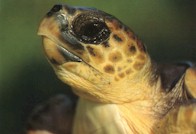
Sea turtles existed in the Mediterranean long before mankind they are infact prehistoric animals. Having survived millions of years, their continuing survival is now being threatened by mans uncontrolled exploitation of their natural environment. Although they spend almost all their life in the sea, the future existence of these ancient reptiles is entirely dependant on the careful maintenance and preservation of certain beaches, where the female turtles return to deposit their eggs. The beaches of Laganas bay in Zakynthos are the most important nesting areas in the Mediterranean, and have been protected, and monitored since 1983 by the Sea Turtle Protecton Society a Greek NGO. From June to August the Loggerheads come to mate and deposit their eggs in the warm sands. female turtles come ashore when the beaches are dark and quiet, dig a hole, the egg chamber, in the sand with their hind flippers, and lay around 120 eggs. After laying, they cover the nests with great care and crawl back to the sea. The eggs are incubated for approximately 55 days, before the turtles come up to the surface and head for the sea. This usually happens during the night or very early in the morning. As soon as they reach the water they swim to the open sea. Having a soft shell and length of only 6 centimetres, the baby turtles are very vulnerable, often falling prey to sea birds and fish.
|
|||||||||